
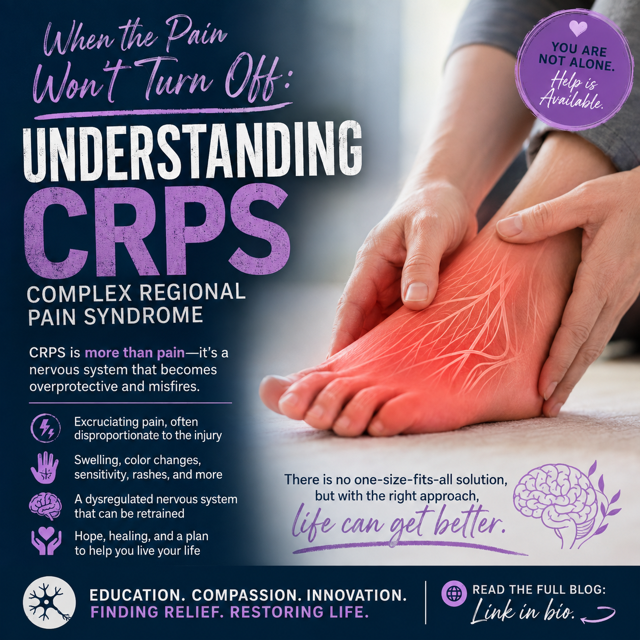
 Complex regional pain syndrome, or CRPS, is one of the most challenging pain conditions I treat.
Part of the difficulty is the intensity of the pain itself. CRPS can cause excruciating burning, stabbing, electric, or hypersensitive pain that seems wildly disproportionate to the original injury. A broken bone may have healed. A surgical incision may look perfect. An MRI may show no new structural damage.
And yet the pain is screaming.
For patients, that disconnect can be devastating. They are not only living with severe pain; many have also spent months or years hearing some version of:
“The bone healed.”
“The surgery went well.”
“There’s nothing on the imaging that explains this much pain.”
But CRPS is not simply a problem of damaged bones, muscles, or joints. It is a disorder involving the way the nervous system processes and amplifies signals.
When the Nervous System Becomes Hypervigilant
I often explain CRPS as a nervous system that has become stuck in a state of hypervigilance.
Normally, pain serves an important purpose. You injure yourself, nerves send warning signals to the brain, and pain encourages you to protect the injured area while it heals.
With CRPS, that protective system appears to become dysregulated. Signals that should be relatively ordinary can become amplified and interpreted as threatening.
A light touch can hurt.
A sock touching the foot can feel unbearable.
Temperature changes can trigger burning pain.
Patients sometimes describe sensations like electrical shocks, insects crawling across the skin, or spiderwebs wrapping around an extremity.
Pain from something that normally should not hurt—such as very light touch—is called allodynia, and it is a classic feature of CRPS.
My patients with CRPS sometimes make me sound like a broken record. They will describe some strange new sensation, and I find myself saying again:
“That can be part of CRPS.”
I never want that response to sound dismissive. Quite the opposite. After treating this condition repeatedly, you begin to recognize its peculiar patterns.
CRPS Is More Than Pain
The condition can produce striking physical changes.
The affected hand or foot may become swollen. The skin can turn red, purple, pale, or unusually shiny. Temperature and sweating can change. Hair and nail growth may become abnormal.
Movement can become increasingly difficult. Muscles and joints can stiffen, and contractures may develop.
Patients sometimes describe the experience as if their brain is telling the hand or foot to move, but the extremity simply refuses to cooperate.
In some cases, symptoms may eventually involve areas beyond the original site of injury.
These findings are part of what makes CRPS such a fascinating—and frustrating—neurological condition.
A Condition With a Long Medical History
Physicians have been describing syndromes resembling CRPS for more than 150 years.
During and after the American Civil War, Philadelphia neurologist Silas Weir Mitchell and his colleagues described soldiers who developed severe burning pain and unusual changes in injured extremities after nerve injuries. The syndrome became known as causalgia, an important predecessor to what we now call CRPS.
Mitchell himself was a fascinating figure in the history of neurology. Later in his career, he even experimented personally with mescaline-containing peyote while investigating its neurological effects.
But that is a story for another day.
The important point is that physicians have been staring at the strange physical manifestations of this disorder for generations and asking many of the same questions:
Why does the skin change color?
Why does the extremity swell?
Why can something feel simultaneously numb and exquisitely painful?
Why can an injury that appears to have healed continue producing such dramatic symptoms?
We understand considerably more today, but there is still much about CRPS that medicine has not completely explained.
The Goal: Retraining the Nervous System
One useful way to think about treatment is that we are trying to help an abnormally sensitized nervous system relearn normal responses.
That is why desensitization therapy can be so important.
Traditional physical therapy often emphasizes strength, flexibility, range of motion, stability, and restoration of normal biomechanics.
Desensitization has a somewhat different objective.
Different textures, pressures, temperatures, movements, and sensations are gradually and compassionately introduced to the affected area.
The message we are repeatedly trying to teach the nervous system is:
Touch is not dangerous. Movement is not dangerous. Sensation does not always mean injury.
This process is gradual. You cannot simply tell an amplified nervous system to stop producing pain.
You have to train it.
And repetition matters.
What If It Hurts Too Much to Begin?
This creates one of the central dilemmas of CRPS treatment.
How do you desensitize a foot when the patient cannot tolerate a bedsheet touching it?
How do you restore movement to a hand when even the slightest contact causes severe pain?
This is where interventional pain management can become particularly useful.
One option is a sympathetic nerve block. Depending on the affected region, medication is placed around sympathetic nerve structures associated with the arm or leg.
The goal is not simply to perform an injection and declare the problem solved.
Ideally, the block creates a temporary window in which pain and sympathetic activity are reduced enough for the patient to move, tolerate touch, participate in therapy, and continue retraining the nervous system.
That distinction is important.
The procedure creates the window. Rehabilitation takes advantage of it.
Medications Work Differently in Nerve Pain
Medication may also help reduce the amplification of pain signaling.
Certain antidepressant and antiseizure medications are used because of their effects on neuropathic pain pathways. These medications do not necessarily behave like traditional painkillers.
You generally do not take a pill, experience immediate relief, wait for it to wear off, and then watch the pain return.
Instead, these medications may gradually alter the way pain signals are processed. Finding the right medication and dose can take time, and treatment needs to be individualized.
When Conservative Treatment Isn’t Enough
Unfortunately, CRPS does not always respond adequately to therapy, medication, and sympathetic blocks.
A patient may work diligently at desensitization but remain trapped because the pain is simply too intense. A nerve block may provide relief, but only temporarily.
At that point, we may consider more advanced approaches.
One of the most important is spinal cord stimulation, including newer neuromodulation strategies such as dorsal root ganglion stimulation in appropriately selected patients.
Neuromodulation uses electrical stimulation to modify pain signaling within the nervous system. Rather than repairing a bone or removing damaged tissue, we are changing how pain information is transmitted and processed.
For some carefully selected patients, I have seen neuromodulation produce transformative improvements.
I deliberately use the word improvement, rather than cure.
The goal may be reducing pain enough that someone can walk farther, tolerate clothing, sleep normally, return to work, exercise, travel, or simply participate more fully in life.
Sometimes that difference is enormous.
[Insert link to our spinal cord stimulation article here.]
Where Ketamine May Fit
Ketamine is another therapy sometimes considered in difficult CRPS cases.
Ketamine is an FDA-approved anesthetic that, when used in different dosing strategies, affects NMDA-receptor signaling involved in pain processing and neuroplasticity. In selected patients, medically supervised ketamine treatment may temporarily reduce severe neuropathic pain or help interrupt a significant flare.
It is not a universal solution, and benefits can be temporary. Like other advanced treatments, its risks and potential benefits need to be evaluated individually.
But when the nervous system seems completely stuck in an amplified pain state, ketamine can sometimes become one component of a broader strategy.
The Most Important Goal Is Getting Your Life Back
There is rarely one injection, medication, device, or therapy that represents the entire answer to CRPS.
The strongest approach is usually multidisciplinary:
- restoring movement and function;
- gradually exposing the nervous system to sensation;
- desensitizing the affected area;
- reducing excessive pain signaling when necessary;
- treating psychological distress and sleep disruption that can accompany chronic pain;
- and using interventions strategically when pain prevents rehabilitation.
But throughout all of this, we cannot lose sight of the real objective.
The ultimate goal is not simply to make a pain score reach zero. The goal is to help someone get their life back.
Living successfully with CRPS may mean reaching a place where pain occupies less and less of your world. You move again. You participate again. You trust your body again. You develop tools for managing flares rather than allowing every flare to dictate your life.
For some patients, accepting that the nervous system may remain imperfectly wired is part of that process. Acceptance does not mean giving up on treatment. It means continuing to pursue improvement without putting your entire life on hold while waiting for absolute perfection.
CRPS can be extraordinarily difficult.
But difficult is not the same as hopeless.
When we combine rehabilitation, desensitization, medication, targeted interventions, neuromodulation when appropriate, and a relentless focus on restoring function, the objective becomes larger than treating pain.
We are teaching the nervous system that it is safe to experience the world again—and helping the person living inside that nervous system start living again.
This article is for educational purposes only and is not a substitute for individualized medical evaluation or treatment. CRPS treatment should be tailored to the individual patient, and not every therapy discussed here is appropriate for every person.